Measuring agriculture’s environmental impact to guide growing and sourcing decisions
How does changing the way a crop is grown affect soil, plant growth and greenhouse gas emissions? We use observations and data to investigate questions that arise on farms. We want our findings to help farmers choose cultivation methods and businesses assess environmental efforts when buying produce.
Our research draws on the concept of planetary boundaries, which describe the environmental limits within which the Earth can function. We study nitrogen cycling and biodiversity alongside greenhouse gas emissions to understand agriculture’s impact from several angles.
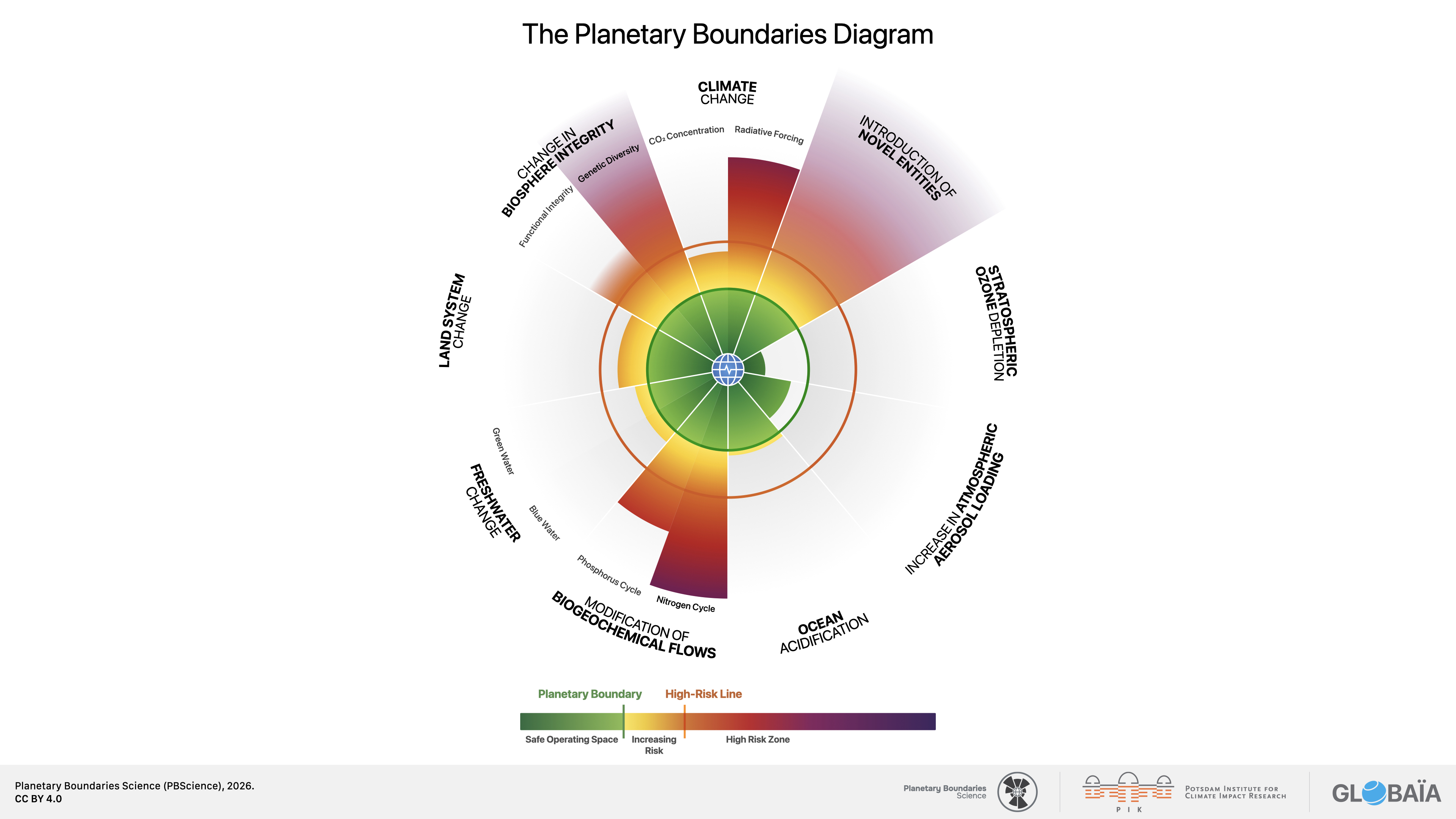
In the 2026 assessment, seven of the nine boundaries have been crossed globally. Farming is closely linked to several of them, including land use, freshwater change and the nitrogen and phosphorus cycles.
Source: Planetary Boundaries Science (PBScience), 2026. Planetary Health Check 2026, Figure 3 · CC BY 4.0How growing practices affect soil and crops
We study how different practices relate to soil microorganisms and crop growth. Observing both soil and plants helps us build knowledge that farmers can use when choosing techniques suited to their fields.
Estimating greenhouse gas emissions and assessing farm practices
We are investigating ways to estimate and assess emissions from farm records. Measuring the effect of individual practices will help farmers explain their work to shoppers and business buyers.
Agricultural Emissions and Japan’s MIDORI Strategy
How much do food and farming contribute to global emissions?
In 2024, agrifood systems accounted for 35% of global greenhouse gas emissions, or 18.5 billion tonnes of CO₂ equivalent, according to the UN Food and Agriculture Organization (FAO). This total covers land-use change, crop and livestock production, and activities such as fertilizer manufacturing, food transport and waste disposal.
Crop and livestock production on farms accounted for 7.9 billion tonnes of CO₂ equivalent, or 43% of agrifood systems emissions.
Greenhouse gas emissions from farming in Japan
Japan’s national greenhouse gas inventory recorded 30.3 million tonnes of CO₂ equivalent from agriculture in fiscal 2024. This category covers sources such as methane from rice cultivation and livestock, and nitrous oxide from agricultural soils. Fuel used by farm machinery is counted in the energy sector.
Source Japan’s national greenhouse gas inventory, chapter 2 (PDF, in Japanese)
Japan’s MIDORI Strategy for Sustainable Food Systems
Japan’s Ministry of Agriculture, Forestry and Fisheries is working to reduce environmental impacts from sourcing through to consumption. One of its goals for 2050 is for organic farming to account for 25% of Japan’s cultivated land. The ministry also uses the Mieru Label to help shoppers recognise farmers’ efforts to reduce environmental impacts.
Source Ministry of Agriculture, Forestry and Fisheries · The MIDORI Strategy (in Japanese)
At AGBIOTECH, we want farmers who practice Environmentally Friendly Agriculture to be able to keep growing. Private Bio Farm connects them with customers who regularly buy their produce. With BioApp, growers can use cultivation records to explain their environmental practices to buyers.
Extending assessment to nitrogen cycles and biodiversity
We plan to study nitrogen cycling on farmland and the effects of agricultural activity on biodiversity. We will examine which indicators and data can describe relationships between farming and the environment beyond carbon emissions.
Putting research to work: From farm records to the Mieru Label
BioApp already connects with the Ministry of Agriculture, Forestry and Fisheries’ environmental impact visualization system. Growers enter cultivation records to estimate their contribution to reducing greenhouse gas emissions relative to typical local practices. We work with farmers to obtain the Mieru Label so customers can see those efforts.
 Vegetable labelGreenhouse gas reduction
 Rice labelGreenhouse gas reduction and biodiversity conservation
Addressing planetary challenges through agriculture
Our work addresses interconnected issues including soil, water and biodiversity as well as carbon emissions. Guided by the concept of planetary boundaries, we aim to tackle these challenges by expanding Environmentally Friendly Agriculture. We also plan to measure and communicate the environmental effects of this work.
Read the ministry’s announcement ↗